Views: 0 Author: Site Editor Publish Time: 2025-11-05 Origin: Site


Ever wondered why the height of a wall-mounted bathtub faucet matters? It’s crucial for both functionality and aesthetics. Setting the right height ensures ease of use and splash prevention. In this post, you'll learn about key considerations, from sink type to user ergonomics, ensuring your faucet is perfectly placed.
When planning your wall-mounted faucet, a good starting point is to position it between 6 to 8 inches above the sink or countertop surface. This height generally provides a comfortable reach for most users, allowing easy access to water without excessive bending or stretching. It also helps prevent water from splashing outside the sink area, keeping your space clean and tidy.
However, this range isn’t a strict rule. Several key factors influence the ideal height for your specific setup:
Sink Type and Dimensions: Larger or deeper sinks, like vessel or farmhouse styles, often require higher faucet placement. For vessel sinks, positioning the faucet closer to 8 inches above the rim ensures the water stream hits the drain area directly, reducing splashes. Conversely, undermount or standard sinks typically need less height.
User Ergonomics: Consider who will use the sink most often. For taller household members, a slightly higher faucet might be more comfortable. For children or shorter users, lower placement improves accessibility. Adjusting height to suit all users enhances both comfort and usability.
Faucet and Water Flow Design: Faucets with long spouts or pull-down features may need to be mounted higher to allow full extension and proper water flow. For example, a faucet with a 10-inch spout will perform best when installed at a height that ensures the water reaches the sink’s center without splashing.
Faucet Characteristics: High-arc faucets require higher mounting points to prevent water from splashing outside the sink. Low-arc designs can be installed closer to the surface, maintaining a sleek look without sacrificing function.
Splash Prevention: Positioning the faucet at an appropriate height ensures the water stream falls directly into the sink’s drain area. This minimizes splashing, especially with larger or rounded sinks where water tends to deflect.
Aesthetic Balance: The visual harmony between the sink, faucet, and surrounding space matters. A faucet too high might look out of proportion, while one too low could seem cramped. Striking a balance enhances the overall design.
Surrounding Fixtures and Wall Features: Nearby shelves, mirrors, or cabinets impact placement. Ensure the faucet height allows for easy access without obstructing other wall-mounted elements or getting in the way of opening cabinets.
In summary, while the 6 to 8-inch guideline offers a solid foundation, customizing the height based on sink type, user needs, faucet design, and aesthetic goals results in a more functional, comfortable, and visually pleasing setup. Consulting with a professional or using design software can help visualize the best placement before installation.
The type and size of your sink play a crucial role in determining the ideal height for your wall-mounted faucet. Different sinks have unique shapes, depths, and widths, all of which influence where and how high the faucet should be installed for optimal function and appearance.
For instance, a deep vessel sink typically requires a higher faucet placement. This ensures the water stream reaches the drain area efficiently, reducing splashing and making handwashing comfortable. Conversely, standard undermount or drop-in sinks usually need less height—around 6 to 8 inches above the countertop—since their rims are lower, and water flow is more straightforward.
The shape of the sink also matters. Rounded or curved bowls tend to cause more splashing if the water hits the sides or the back of the bowl. To minimize this, position the faucet so the water stream hits near the drain or the center of the sink. For square or flat sinks, splash risk is lower, allowing more flexibility in placement.
When selecting the height, consider the sink's dimensions. Measure from the bottom of the faucet to the top of the sink rim, ensuring at least 1-2 inches of clearance. This space allows for comfortable use, prevents water from splashing out, and accommodates any decorative or functional features like soap dishes or accessories.
Additionally, the faucet's reach should be proportional to the sink's size. A longer spout extends farther into the sink, so the mounting height must be adjusted accordingly. For example, if your faucet has a 10-inch spout, mounting it too low could cause splashing outside the sink, while mounting it too high might look disproportionate.
In summary, understanding your sink’s type and dimensions helps you choose a faucet height that balances functionality, aesthetics, and user comfort. Always measure carefully before installation, and consider testing different heights with temporary fixtures or sketches to visualize the final look and performance.
When choosing the height for your wall-mounted faucet, user comfort should be a top priority. Think about who will be using the sink most often. For adults, a height of about 6 to 8 inches above the sink surface generally works well, providing easy access without stretching or bending. However, if children or shorter users will frequently use the sink, lowering the faucet slightly can make a big difference. Conversely, taller users might prefer a slightly higher placement for comfort.
Imagine a family with members of varying heights. In such cases, a compromise is often best—setting the faucet at a height that balances accessibility for everyone. This might mean installing it at the higher end of the recommended range but ensuring the water stream still falls comfortably into the sink.
In multi-user households or commercial settings, customizing faucet height becomes even more important. Consider adjustable or flexible faucets, such as pull-down or pull-out models, which can be moved to suit individual preferences. For fixed wall-mounted faucets, you might opt for a middle ground height, then adjust the sink or countertop design to accommodate different users.
Another approach involves installing the faucet slightly higher than usual for taller users and adding ergonomic features like lever handles positioned conveniently for people of all heights. This ensures everyone can comfortably operate the faucet without awkward movements or strain.
Test with temporary fixtures: Use painter’s tape or mock-up placements to visualize the best height.
Consider handle placement: Handles should be reachable without excessive arm movement.
Account for sink depth: Deeper sinks may require slightly higher faucet placement to prevent splashing.
Think about the water flow: Ensure the water stream hits the center or drain area of the sink for optimal use.
By tailoring the faucet height to your household’s needs, you improve usability and reduce discomfort. Properly positioned faucets not only enhance user experience but also prevent strain or accidental splashes, making daily routines smoother.
Tip: Always consider the primary users' heights and preferences when setting wall-mounted faucet height to ensure maximum comfort and accessibility for everyone.
The design of your wall-mounted faucet plays a big role in deciding its height above the sink. Faucets come with different spout lengths and shapes, which affect how far the water reaches and where it lands in the sink. For example, a faucet with a long spout needs to be mounted higher to allow the water to flow comfortably without splashing. Meanwhile, short-spout faucets can be installed lower since their reach is limited.
Pull-down or pull-out faucets add another layer to consider. These designs require enough clearance to fully extend their spray heads. If mounted too low, the spray might not reach all parts of the sink, limiting functionality. So, when choosing a faucet with these features, plan for a higher installation height to maximize their use.
The water flow pattern also matters. Some faucets produce a narrow, focused stream, while others offer a wider, aerated flow. A focused stream usually needs precise height placement to avoid splashing off the sink’s edges. Wider flows may tolerate more height variation but can cause more splash if the faucet is too high.
Proper water flow depends on the faucet height and how the water hits the sink. Position the faucet so the stream lands near the center or drain area. This reduces splashing and keeps water inside the sink. If the faucet is too high, water falls from a greater distance, increasing splash risk. Too low, and the stream might hit the sink’s sides or back, causing water to bounce out.
Also, consider the sink’s shape and depth. Deeper sinks allow more height without splashing, while shallow or curved sinks need careful faucet placement. For rounded sinks, aim to have the water stream hit close to the drain to avoid deflection and splash.
If your faucet has adjustable flow settings, test these at the chosen height. Some settings may splash more than others depending on the height and sink shape. Adjust the height or flow rate to find the best balance between water pressure and splash control.
Imagine a kitchen with a wall-mounted faucet featuring a 10-inch spout and a pull-down spray. Mounting it 8 inches above the sink rim ensures the spray head can fully extend and reach all sink areas. The water stream falls near the drain, reducing splash and making washing easier.
In contrast, a bathroom faucet with a shorter spout and a gentle flow can be installed closer to the sink, around 6 inches high, providing a neat, compact look without splash issues.
The design of your wall-mounted faucet greatly influences its ideal installation height. Faucets come in a variety of styles, each with unique features that affect how high they should be mounted. For example, high-arc or gooseneck faucets have a tall, curved spout that extends further into the sink area. Installing these too low can cause water to splash outside the sink, while mounting them too high might look disproportionate or cause water to fall from a greater height, increasing splash risks.
Low-arc faucets, with a shorter, straight spout, usually require less mounting height. They tend to be more streamlined and are often used in spaces where a minimalist look is desired. Because their water streams fall closer to the sink surface, they are more forgiving in terms of placement height, but ensuring the water hits the center of the sink remains important.
High-Arc Faucets:
Feature a tall, curved spout, often exceeding 10 inches in height.
Ideal for larger sinks, vessel sinks, or when extra clearance is needed for filling tall pots or washing large items.
Require higher mounting points—usually between 8 to 10 inches above the sink rim—to prevent splashing and ensure proper water flow.
Low-Arc Faucets:
Have a shorter, straight spout, typically under 8 inches high.
Suitable for smaller sinks, bathrooms, or spaces with limited clearance.
Can be mounted closer to the sink surface—about 6 inches above the rim—without risking splashes.
Choosing between these styles depends on your sink type, aesthetic preference, and functional needs. High-arc faucets provide a dramatic, modern look but need careful planning to avoid water splashes. Low-arc faucets offer a sleek, minimalist appearance, fitting well into compact spaces.
When selecting faucet height based on design, consider the reach of the spout. Longer spouts require more vertical clearance to operate comfortably. Also, think about the handle style—single lever or dual handles—and their placement relative to the faucet height. Proper positioning ensures ease of use for all users.
In summary, understanding your faucet’s design helps determine the best height for installation. It balances aesthetics, functionality, and splash prevention, making your space both beautiful and practical. Always refer to manufacturer guidelines for specific recommendations, and test different heights with temporary setups if possible.
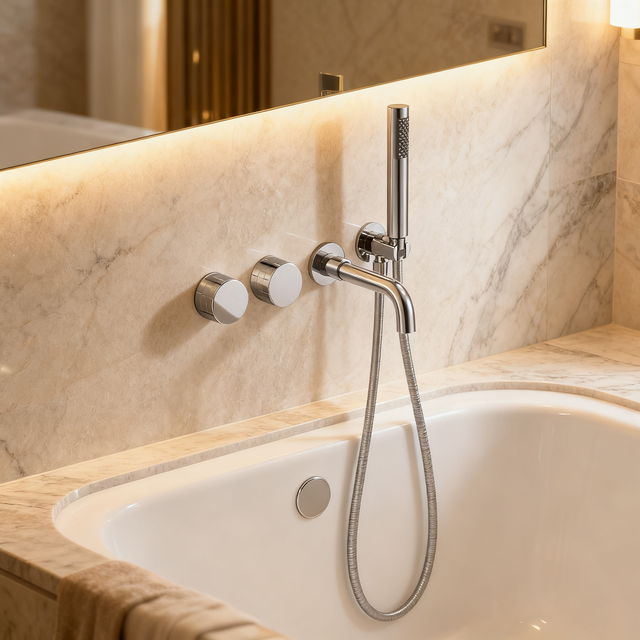
Splashing is a common challenge when installing wall-mounted faucets. Water falling from too high can scatter, creating messes around the sink area. To reduce this, position the faucet so the water stream lands directly over the sink’s drain or center. This ensures water hits a stable surface, minimizing bounce and splash.
Another effective technique is to adjust the water flow rate. A gentler stream reduces the force that causes splashing. Aerators or flow restrictors can help soften the water flow, making it more controlled and less likely to splash.
Choosing the right faucet spout design also plays a role. Spouts that direct water downward or slightly angled toward the drain help keep water contained. Avoid spouts that shoot water straight out horizontally, as they often cause more splash.
For sinks with curved or rounded bowls, extra care is needed. Water tends to deflect off curved surfaces more easily, increasing splash risk. In these cases, lowering the faucet height slightly or angling the spout to aim closer to the drain can help.
Height Matters: Keep faucet height within 6 to 8 inches above the sink rim for most sinks. This range balances user comfort and splash control.
Stream Targeting: Aim the water stream at the sink’s lowest point or drain. This reduces water bouncing off sides.
Consider Sink Shape: Flat or square sinks splash less, so faucet placement can be more flexible. Rounded sinks require precise targeting.
Spout Reach: Ensure the spout extends far enough to reach the center of the sink but not so far that water falls outside the basin.
Test Before Final Installation: Temporarily position the faucet and run water to observe splash patterns. Adjust height or angle as needed.
By combining these techniques, you can significantly reduce splashing, keeping your sink area cleaner and more pleasant to use.
When choosing the height for your wall-mounted faucet, aesthetics matter just as much as practicality. The right placement can enhance the overall look of your space, making it appear more balanced and cohesive. A faucet that’s too high might look out of proportion, especially if the sink is small or delicate. Conversely, a faucet placed too low can seem cramped or awkward, disrupting the visual harmony.
Think about the style of your room—modern, traditional, industrial—and select a height that complements that aesthetic. For example, high-arc faucets with sleek, curved lines often look best when mounted higher, creating a dramatic and contemporary effect. Low-arc or straight-spout faucets may sit closer to the sink surface, maintaining a clean, minimalist appearance.
Achieving visual harmony involves considering the size and shape of your sink, countertop, and nearby fixtures. The goal is to create a unified look where all elements work together. For instance, a large vessel sink pairs well with a taller faucet, emphasizing its bold presence. Smaller sinks benefit from lower-mounted faucets to avoid overwhelming the space.
Pay attention to the proportion between the faucet and the sink. A good rule of thumb: the faucet should neither overpower nor get lost among other fixtures. It should serve as a focal point that enhances the overall design. Matching finishes, such as brushed nickel or matte black, also help create a cohesive aesthetic.
Test with mock-ups: Use painter’s tape or temporary fixtures to visualize the placement.
Consider the room's height: Ensure the faucet height aligns with ceiling height and other wall-mounted features.
Maintain symmetry: Position the faucet symmetrically with other elements like mirrors or cabinets.
Match design style: Choose faucet styles that reflect your overall decor—sleek and modern or ornate and traditional.
In the end, the goal is to find a height that makes your space look stylish while remaining functional. A well-placed faucet can serve as a statement piece or seamlessly blend into your design, elevating the entire room.
When installing a wall-mounted faucet, it's essential to think about other fixtures and features on the same wall. These elements can influence where you place the faucet for both practical use and visual appeal.
First, look at nearby fixtures like shelves, cabinets, or mirrors. These can obstruct access or make it difficult to operate the faucet comfortably. For example, if a mirror hangs too low or a shelf extends over the sink area, it might interfere with the faucet's placement or usage. To avoid this, ensure there’s enough space between the faucet and these features. Typically, leaving at least 2-4 inches of clearance helps prevent obstruction and makes operation smoother.
Next, consider the size and placement of cabinets or vanities. If a cabinet door opens outward, you want to position the faucet so it doesn’t block access. Similarly, if there are wall-mounted storage units, verify that the faucet height doesn’t interfere with opening or closing them.
Mirrors also play a role. A mirror placed directly above the sink can be a focal point, but its height and width might limit where the faucet can be installed. For example, if the mirror is large and extends downward, placing the faucet too high could look unbalanced or cause water splashes onto the mirror surface. Planning the placement so the faucet aligns well with the mirror enhances both function and aesthetics.
Wall features like decorative tiles, wall art, or lighting fixtures can also influence faucet placement. For instance, if you have a decorative tile pattern or a wall-mounted light fixture, you want the faucet to complement these elements rather than clash with them.
Finally, think about the overall flow of the space. The faucet should be positioned for easy access without crowding other elements. Proper spacing ensures that users can wash their hands or dishes comfortably without knocking into nearby fixtures or wall features.
In summary, evaluating surrounding fixtures and wall features ensures your wall-mounted faucet fits seamlessly into the space. It improves usability, maintains visual harmony, and prevents future adjustments or rework. Planning ahead helps create a balanced, functional, and stylish environment.
When installing a wall-mounted faucet, several practical factors can influence the success and longevity of your setup. These considerations help prevent future problems, ensure safety, and make maintenance easier.
Avoid Wall Obstructions
Before finalizing the faucet height, inspect the wall thoroughly. Look for hidden elements like studs, electrical wiring, or existing plumbing that could interfere with the installation. Obstructions can cause misalignment, complicate plumbing connections, or even damage the wall. Using a stud finder or consulting building plans helps identify potential issues early. Ensuring clear space behind the wall prevents costly adjustments later.
Check Wall Cavity Depth
The depth of the wall cavity is crucial for accommodating the faucet and plumbing components. If the cavity is too shallow, pipes and fixtures may not fit properly, leading to installation challenges. Especially in retrofit projects, measure the wall's thickness accurately. If the cavity isn’t deep enough, consider options like adding a wall box or modifying the wall structure. Proper cavity depth ensures the faucet sits flush and functions smoothly.
Consult a Professional
While some homeowners may feel comfortable with DIY projects, wall-mounted faucet installation often requires expertise. Professional plumbers or designers can assess your space, recommend optimal height, and handle complex plumbing work. They can also identify potential issues with wall support, plumbing alignment, or aesthetic integration. Investing in expert advice reduces the risk of leaks, misalignment, or damage, saving money in the long run.
Choosing the right wall-mounted faucet height involves considering factors such as sink type, user ergonomics, and aesthetic balance. Proper placement enhances functionality and prevents splashing, ensuring a comfortable and visually appealing setup. Consulting with professionals can further refine the installation. Kaiping Landon Plumbing offers high-quality faucets that cater to these needs, providing both style and practicality. Their products ensure a seamless integration into any space, delivering exceptional value and performance for homeowners seeking the perfect faucet solution.
A: A Wall Mounted Bathtub Faucet is a faucet installed on the wall above a bathtub, providing water flow directly into the tub.
A: Consider factors like sink type, user ergonomics, and faucet design to determine the optimal height for a Wall Mounted Bathtub Faucet.
A: Proper height placement of a Wall Mounted Bathtub Faucet ensures water falls directly into the tub, minimizing splashes and keeping the area clean.
A: Wall Mounted Bathtub Faucets offer aesthetic appeal, save counter space, and provide flexible installation options for various bathroom designs.


